In this guide
Absorption chillers produce chilled water using heat as the driving energy instead of an electrically driven compressor. It is one of the most elegant ideas in industrial engineering — and, wherever waste heat, steam or hot water is available, one of the most economical ways to make cooling.
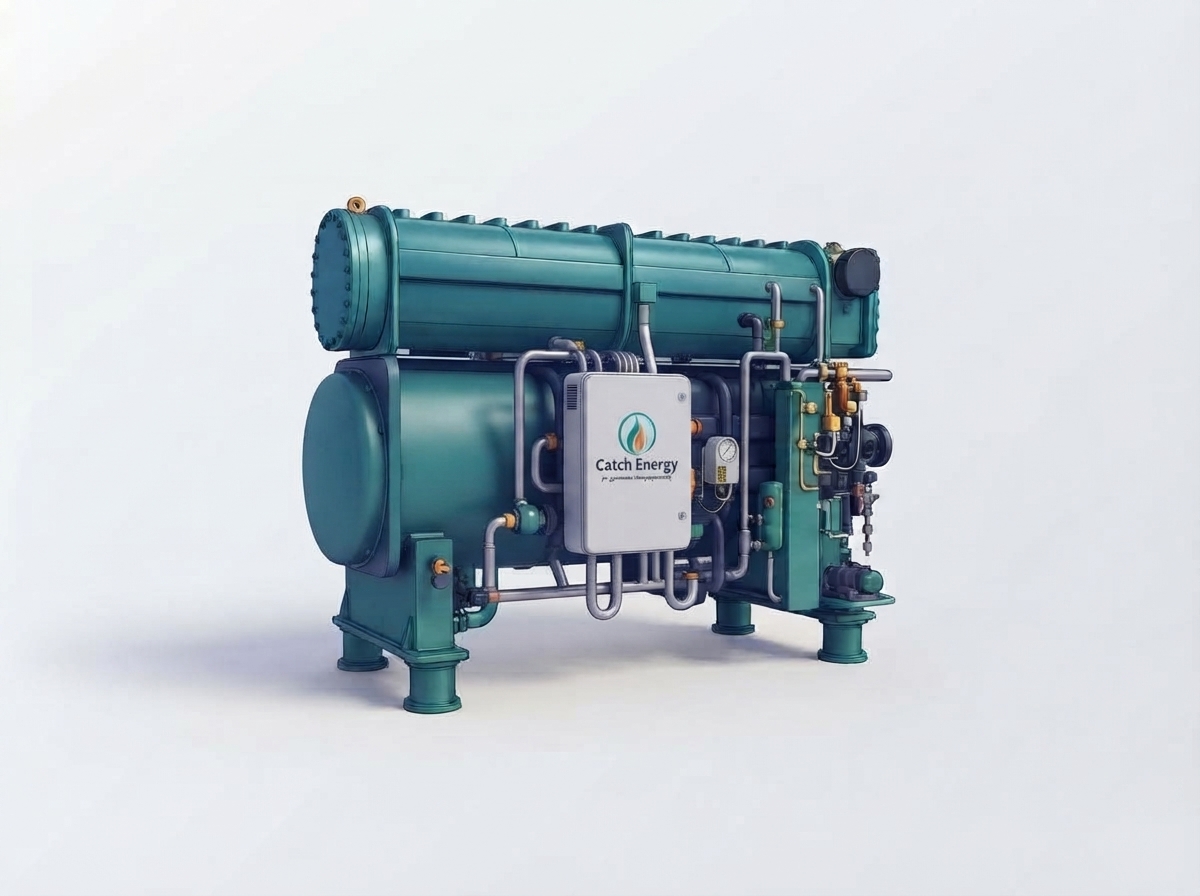
Walk into the plant room of a hospital, a district energy centre, a pharmaceutical facility or an increasing number of data centres, and among the pumps and pipework you may find a large steel vessel quietly turning heat into cold. That machine is an absorption chiller. Unlike the vapour-compression chillers most people know — which use a large electric motor to drive a compressor — an absorption chiller has almost no moving parts and draws only a few kilowatts of electricity for its small pumps. The heavy lifting is done by heat and chemistry.
This guide explains exactly how absorption chillers work, from the underlying physics to the four vessels that make up the machine, the difference between single and double-effect designs, and the two things — vacuum and lithium bromide chemistry — that determine whether a machine lasts twelve years or thirty. It is written by engineers who service these machines across the UK and Europe every week.
The core idea: heat in, cooling out
A conventional chiller uses an electric compressor to raise the pressure of a refrigerant vapour. That compression is the expensive part — it is where the electricity goes. An absorption chiller replaces the compressor entirely with a thermochemical process: it uses heat to drive the refrigerant around the cycle instead of electricity.
The consequence is dramatic. Where a vapour-compression chiller of, say, 1 MW cooling capacity might draw 200–300 kW of electrical power, an absorption chiller of the same capacity draws only a handful of kilowatts for its solution and refrigerant pumps. If the driving heat is free — waste heat from an engine, surplus steam, or heat from a district network in summer — then the cooling it produces is close to free too. That single fact is why absorption chillers appear wherever heat and a cooling load exist side by side.
The one physical principle everything rests on
To understand an absorption chiller, you only need to grasp one piece of physics: water boils at a lower temperature when the pressure is lower. At sea-level atmospheric pressure water boils at 100 °C. Reduce the pressure and the boiling point falls. Inside the evaporator of a lithium bromide absorption chiller, the pressure is held at roughly 0.8 to 1 kilopascal absolute — about one-hundredth of atmospheric pressure. At that pressure, water boils at around 4 °C.
This is the whole trick. If you can make water boil at 4 °C, then the act of boiling — which absorbs heat from its surroundings — will chill anything nearby. In an absorption chiller, "nearby" means the tubes carrying the building's or process's chilled water. Water sprayed over those tubes boils at low temperature and pressure, pulling heat out of the chilled water flowing inside them, cooling it to the 6–7 °C that leaves the machine to do useful work.
The working pair: water and lithium bromide
Boiling water at 4 °C produces water vapour, and that vapour has to go somewhere. If it simply accumulated, the pressure would rise and the boiling point would climb, and the cooling effect would stop within seconds. So the machine needs something to continuously absorb that vapour and keep the vacuum deep. That something is lithium bromide.
Lithium bromide (LiBr) is a salt with an exceptionally strong affinity for water — it is hygroscopic to an extreme degree. A concentrated solution of lithium bromide in water will greedily absorb water vapour out of the space around it. In an absorption chiller the refrigerant is pure water and the absorbent is lithium bromide solution. This is called the working pair: water as the refrigerant, lithium bromide as the absorbent.
This pairing is why absorption chillers are so benign environmentally. The refrigerant is ordinary water — zero ozone depletion potential, zero global warming potential, no F-gas regulations, no leak-check regime, no phase-down timetable. In an age of tightening refrigerant rules, that is a growing advantage.
The four vessels — a walk around the machine
An absorption chiller is built around four functional sections. In a real machine they are often combined into one or two shells, but functionally there are four: evaporator, absorber, generator and condenser. Let us follow the water around the loop.
1. The evaporator — where cooling happens
Refrigerant water is sprayed over a bundle of tubes carrying the building's chilled-water circuit. Under the deep vacuum, this water boils at about 4 °C, absorbing heat from the chilled water inside the tubes and cooling it to roughly 6–7 °C. That chilled water leaves the machine to serve air-handling units, process loads or cold rooms. The refrigerant, now vapour, drifts toward the absorber.
2. The absorber — where the vacuum is maintained
Here the concentrated lithium bromide solution is sprayed into the vapour space. It absorbs the incoming water vapour, keeping the pressure low and the evaporator boiling. Absorption is an exothermic process — it releases heat — so the absorber is cooled by the condenser-water circuit (typically from a cooling tower or dry cooler). As it absorbs water, the lithium bromide solution becomes progressively more dilute. This diluted solution is then pumped up to the generator to be re-concentrated.
3. The generator — where the driving heat goes in
This is where your heat source does its work. The dilute lithium bromide solution is heated — by hot water, steam, exhaust gas or a direct gas flame — until the water boils back out of it. Boiling off that water re-concentrates the lithium bromide, which then returns to the absorber ready to absorb again. The water vapour driven off in the generator travels to the condenser. The generator is the absorption chiller's equivalent of the electric compressor — and heat, not electricity, powers it.
4. The condenser — closing the loop
The water vapour from the generator meets the cooling-water circuit in the condenser and condenses back to liquid water. That liquid passes through a restrictor into the low-pressure evaporator, where it flashes back down to evaporator pressure and temperature — ready to be sprayed over the chilled-water tubes and boil at 4 °C once more. The cycle repeats, continuously and quietly.
The cycle in one loop
- Evaporator: refrigerant water boils at ~4 °C, chilling the building's water.
- Absorber: lithium bromide drinks the vapour, holding the vacuum; heat rejected to cooling water.
- Generator: driving heat boils water back out, re-concentrating the solution.
- Condenser: vapour condenses, returns to the evaporator, and the loop closes.
Single-effect vs double-effect: two grades of efficiency
Not all absorption chillers are equally efficient, and the difference comes down to how cleverly they use the driving heat. Efficiency is measured as the coefficient of performance (COP) — the cooling produced divided by the heat put in.
Single-effect machines
The simplest design has one generator and achieves a COP of roughly 0.7 to 0.8. That means for every kilowatt of driving heat, you get about three-quarters of a kilowatt of cooling. Single-effect machines run on relatively low-grade heat — hot water from about 80 to 120 °C — which makes them ideal partners for CHP engine jacket water, district heating networks and solar thermal systems, where large amounts of moderate-temperature heat are available.
Double-effect machines
A double-effect chiller adds a second, higher-temperature generator. The vapour boiled off in the first (high-temperature) generator is hot enough to be used as the heat source for a second generator, extracting a second round of cooling from the same energy. This roughly doubles the efficiency to a COP of 1.2 to 1.45. The trade-off is that double-effect machines need higher-grade driving heat: steam at 3–10 bar, hot exhaust gas, or direct firing. They suit process industries with steam infrastructure and trigeneration schemes using engine exhaust.
| Design | Driving heat | Typical COP | Best suited to |
|---|---|---|---|
| Single-effect | Hot water 80–120 °C | 0.7 – 0.8 | CHP jacket water, district heating, solar |
| Double-effect | Steam / exhaust | 1.2 – 1.45 | Process steam, trigeneration |
Why the vacuum is everything
Because the entire machine operates far below atmospheric pressure, the pressure difference always acts inward. If there is a leak, air is drawn in — refrigerant is never pushed out. And even a small quantity of air, or of other non-condensable gases generated by internal corrosion, is enough to cause serious trouble.
Non-condensable gases collect in the absorber, where they blanket the tube surfaces and impede the absorption of water vapour. This raises the pressure in the evaporator, which raises the boiling temperature of the refrigerant, which raises the temperature of the chilled water leaving the machine. The symptoms creep in gradually: chilled water that drifts above setpoint, a purge unit running more and more often, and a slow, frustrating loss of capacity over weeks.
This is why professional absorption chiller maintenance revolves around vacuum integrity: 24-hour vacuum decay testing, purge-system servicing, and prompt leak detection the moment the numbers trend the wrong way. A machine that holds its vacuum will hold its performance. One that leaks will quietly lose capacity until someone investigates. We cover this in depth in our absorption chiller service guide.
Crystallisation — the failure mode to respect
Lithium bromide solution has a limit. If it becomes too concentrated while its temperature falls too low, the salt begins to come out of solution and crystallise — turning to a slush and then a solid that blocks the solution heat exchanger and stops the machine. Crystallisation is the classic absorption chiller failure, and it is almost always caused by one of a handful of things: cooling water that is too cold, a loss of power that interrupts the dilution cycle before shutdown, air leaks that push the controls toward ever-higher concentrations, or a faulty sensor steering the concentration control wrongly.
Modern machines manage the risk automatically with dilution cycles and control logic, and recovery from a crystallisation event is possible through controlled heating of the affected heat exchanger. But recovery is a specialist job, and prevention — correct operation, cooling-water control, prompt attention to vacuum, and sensor calibration — is always cheaper than cure.
Where absorption chillers make commercial sense
Absorption cooling is not the right answer everywhere. Where clean electricity is cheap and no waste heat exists, a modern electric chiller with a COP of 5 or more will cost less to run. But wherever heat is available and would otherwise be wasted, absorption cooling becomes compelling:
- Trigeneration and CHP: converting engine jacket-water and exhaust heat into cooling keeps the engine fully utilised in summer, when heat demand collapses. See our guide to trigeneration and CHP cooling.
- District energy: absorbing surplus network heat in summer to serve cooling loads, balancing the scheme across the seasons.
- Process industry: using waste steam or exhaust to offset electrically driven chiller load.
- Data centres: pairing on-site generation or purchased waste heat with absorption cooling for resilient, low-carbon capacity — explored in our data centre absorption cooling guide.
- Hospitals and campuses: reliable, quiet, low-maintenance cooling with a service life measured in decades.
How long do absorption chillers last?
With disciplined maintenance — annual lithium bromide analysis, vacuum management, tube cleaning and controls care — absorption chillers routinely run for 25 to 30 years and beyond. There are very few moving parts: two or three hermetic pumps and some valves. The machines that fail early are almost always the ones that were neglected — their vacuum allowed to degrade, their solution chemistry never checked, their symptoms ignored until capacity had collapsed.
That longevity is one of the strongest arguments for the technology. An absorption chiller is a long-term asset, and looking after its chemistry and its vacuum is far cheaper than replacing it. If you have a heat source and a cooling load, it may be one of the best investments on your site. And if you already have one, everything good flows from two disciplines: keep the vacuum tight, and keep the lithium bromide healthy.
Need help with your absorption plant or heat recovery project?
Catch Energy services absorption chillers and heat pumps across the UK & Europe — and we answer technical questions for free.
Talk to an engineer